
Enhancing Children’s Creativity: How Art Activities Provide Cognitive Benefits
Creativity is a key factor in the upbringing of children, fostering problem-solving skills, thinking, and emotional expression. Paper-cutting tasks, from cutting simple shapes and patterns to producing elaborate DIY art pieces, are not only fun; they present an array of learning opportunities that enrich the learning experience for a child.
The Cognitive and Developmental Benefits of Making
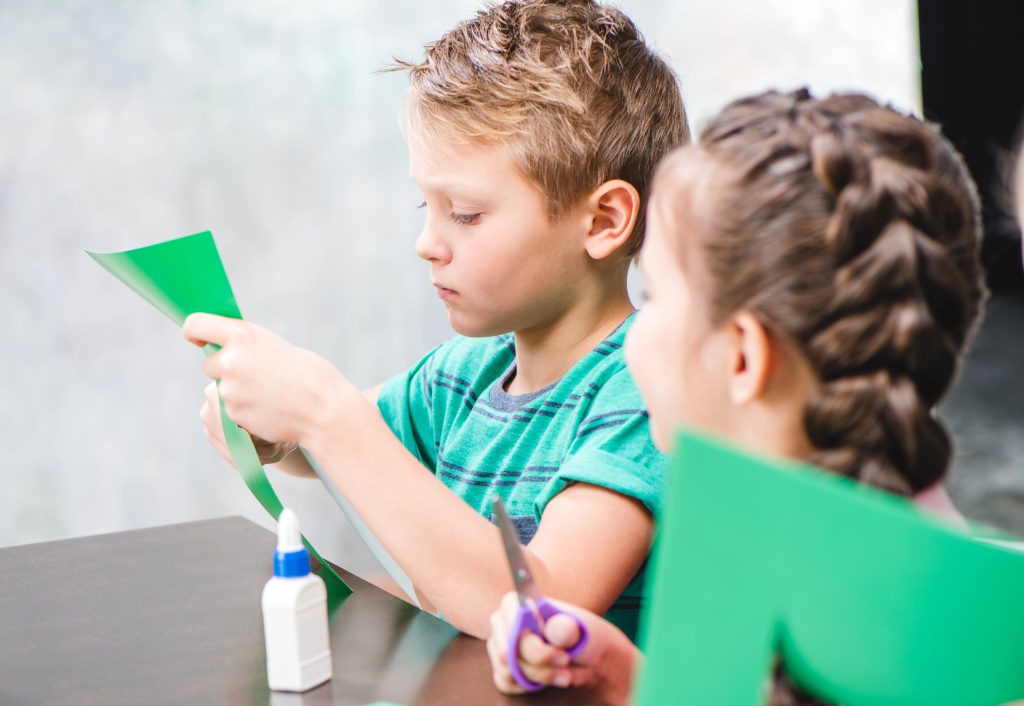
Making activities engage a variety of areas of a child’s brain, reinforcing essential developmental skills. By active manipulation, children sharpen their fine motor skills, hand-eye coordination, and spatial knowledge. Cutting, gluing, and drawing require precise movements that reinforce muscle control and dexterity, the foundation for future academic activities like writing and typing.
Also, developing encourages innovation and problem-solving. Kids have a tendency to encounter setbacks—perhaps there is missing stuff or an unexpected issue in their project—while working on a craft activity. This encourages creativity in finding solutions to problems that occur, something they will find themselves using over and over again at school as well as in a career.
Other than physical development, crafting enhances thinking abilities such as recognizing patterns, sequencing, and memory recall. Step-by-step crafting instructions better equip children in organizing information into a logical process. There is an implied supposition from studies that hands-on experience early through crafting has helped enhance the student’s classroom achievement later by getting the child accustomed to focusing attention, retaining new information, and performing critical thought.
Creativity and Emotional Expression
Maybe the most significant advantage of crafting is how it promotes self-expression. Unlike traditional academic studies, art and craft activities give children the liberty to discover and experiment with ideas without fear of failure. Free-flowing creativity builds self-confidence, strength, and a sense of accomplishment, having a positive self-image.
In addition, crafting is also a relaxing activity that helps children manage stress and emotions. It has been suggested by studies that creative activity helps to ease anxiety and increase concentration.
Through the use of the arts, children can express feelings, thoughts, and experiences constructively and safely. Through painting, sculpting, or collaging, they can convey emotions that are difficult to verbalize. This is particularly helpful for those children who have difficulty with communication, as it allows them to develop greater emotional intelligence and self-awareness.
Encouraging Writing Through Crafting
Although writing mainly is a hands-on activity, it is also an excellent way of honing one’s writing skill. For example, after finishing a craft, children can write a short story or description about what they have done. That little exercise refines their skill in putting thoughts into words, enriches vocabulary, and sentence structure.
For students facing challenges with writing assignments, seeking academic support can be invaluable. When it becomes difficult to organize thoughts or meet deadlines, turning to services that offer to “do my assignment for me” ensures that the work is handled by experts, allowing students to overcome academic hurdles with ease.
A second way of integrating writing with crafting is by having children keep a creativity journal. In this, they write about their crafting work, document step-by-step instructions for projects, or even create fictional stories out of their crafts. Not only does this enhance their writing but also their sequencing, logic, and descriptive writing.
Crafting as a School Learning Tool
Many educators include crafts as part of lesson plans in science class, mathematics class, and history class to improve learning. For example, a simple volcano model can make a lesson on geology interactive and geometric artwork is used to increase comprehension of mathematics. In the use of crafting in education, teachers can improve learning for students in a more memorable and interactive manner.
Schools, such as the National Endowment for the Arts, refer to the need for arts education based on studies showing that arts activities have a direct correlation with improved academic performance. Students who do arts and crafts excel in reading and math since this shows the general benefit of incorporating creativity into education.

Hands-on activities are particularly beneficial for kinesthetic learners—children who learn most effectively through active movement. For students like these, crafting can bridge the gap between theory and practice, connecting abstract subjects to concrete reality.
Digital Crafting: Expanding Creativity in the Digital Age
With technology in its ascendancy, crafting has expanded beyond traditional paper and glue projects. The internet, with software such as drawing programs, 3D modeling software, and coding websites, allows children to be inventive in new and novel ways. Sites like Smithsonian Learning Lab offer interactive resources that marry digital learning and creative discovery, opening doors to education for children in a whole new manner.
The arrival of virtual reality (VR) and augmented reality (AR) also offers new means of digital crafting. Google’s AR Experiments is a case in point of a website where children can engage with digital art projects that blend the physical and the digital. These technologies provide opportunities for the thrilling new means of constructing artistic and technological skills simultaneously.
Practical Advice for Encouraging Creativity Through Crafts
Parents and educators can all do simple things to promote creativity through craft activities:
Make it a craft-friendly environment: Offer a designated space well-stocked with simple materials like colored paper, glue, scissors, markers, and recyclables.
Encourage open-ended activities: Instead of providing explicit instructions, let children have choices about design and materials.
Engage storytelling: Ask children to describe or write about their craft project to promote literacy.
Find inspiration in the real world: Trips to museums, walks in nature, or even items in and around the home can inspire unique craft projects.
Compliment their work: Displaying children’s artwork or sharing it with family and friends boosts their confidence and inspires them to make more.
Educate in multicultural craft projects: Exposing children to different traditions of art fosters awareness of cultures and an appreciation of diversity.
Combine craftsmanship with science experiments: Active experiences like creating slime, making a homemade lava lamp, or building simple electric circuits introduce children to STEM concepts in an engaging and interactive way.
Conclusion
Crafting is so much more than an enjoyable pastime—it is an important learning tool that encourages cognitive, emotional, and creative development in children. The inclusion of crafts in everyday learning routines enables parents and educators to foster a love of creativity while reinforcing fundamental academic skills.
By recognizing the profound impact of arts and crafts on child development, parents, teachers can tap its potential to enrich learning to become more engaging, inclusive, and enjoyable. From traditional arts and crafts to digital creativity, setting up an atmosphere that fosters imagination and expression will serve children both academically and individually.